Love Poems in Disputed Land – Tawang
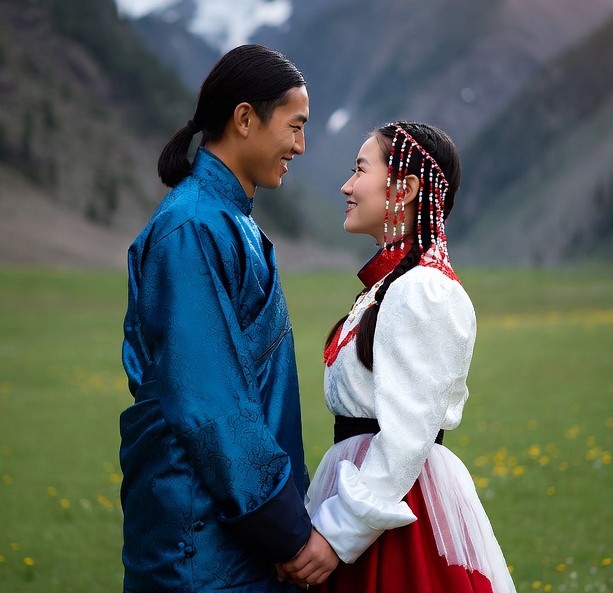
To some, he was just a disgraceful wayward monk who had broken every monastic vow. Some even thought he was a fake tulku. To others, he was a living Buddha who used his love poems to guide the common men and women towards enlightenment. Who was Tsangyang Gyatso?

A member of the Monpa tribe, Tsangyang Gyatso was born in the town of Tawang in 1683. At the age of 13, he was identified as the reincarnation of the 5th Dalai Lama who passed away in 1682. Right from the start, Tsangyang Gyatso was a most reluctant Dalai Lama. Though he did not reject or deny his position as the 6th Dalai Lama, he only wore his monk’s robes during ceremonies. On most days, he would walk the streets of Lhasa, composing songs and poems while getting intoxicated in the company of women. He was said to have many lovers and when rumours reached Peking, the Chinese emperor believed he was a fake.
Nevertheless, Tsangyang Gyatso is still one of the most popular Dalai Lamas. His songs and poems have survived till this day. He was such an icon for romantic poems that instead of stealing his verses, some anonymous poets have attributed their creations to him, making him look larger than life.

As controversial as Tsangyang Gyatso is his birthplace. Present-day Tawang is situated in the disputed territory of Arunachal Pradesh. To understand why it is disputed, we need to travel back in time.
The British Younghusband expedition, an Indian army led by LTC Francis Younghusband, began in December 1903 and lasted until September 1904. The original purpose of the expedition was to occupy Tibet before Russian forces could. It was effectively a temporary invasion by British Indian Armed Forces under the auspices of the Tibet Frontier Commission. The purported mission was to establish diplomatic relations and resolve the dispute over the border between Tibet and Sikkim.

By 1904, the Sikh and Gurkha British forces pushed all the way to Lhasa. Tibet became a protectorate of the British Empire. In 1910, Qing China sent a military expedition to Tibet and came close to re-conquering Tibet before the Qing dynasty fell in the 1911 revolution which paved the way for the Republic of China. Tibet remained under British protection until 1914 when the 13th Dalai Lama decided to settle the status of his country once and for all.
The Shimla Convention of 1914 provided that Tibet would be divided into “Outer Tibet” and “Inner Tibet”. Outer Tibet, which roughly corresponded to Ü-Tsang and western Kham, would “remain in the hands of the Tibetan Government at Lhasa under Chinese suzerainty”. China would have no part in its administration. Only “Inner Tibet”, roughly equivalent to Amdo and eastern Kham, would be under the jurisdiction of the Chinese government.
The convention with its annexes awkwardly defined the arbitrary boundary between Tibetan communities under Tibetan rule and similar communities under Chinese rule. In the south, another arbitrary line demarcated the border between Tibet and British India with similar Tibetan communities on both sides. The latter demarcation would be known as the McMahon Line.

Henceforth, territories south of the McMahon Line came under British India while “Outer Tibetan Tibet”, drawn out with mutual agreement, gained de facto independence from China and Britain under the 13th Dalai Lama.
After the end of the Chinese civil war in 1949, the People’s Liberation Army marched into Tibet and ended its independence with Tibet’s acquiescence to the 17 Point Agreement. Tibet was then headed by the 14th Dalai Lama who reluctantly accepted China’s demands. Tibetan autonomy turned out to be a myth when the Communists lost patience with Tibet’s slow pace of modernisation and took complete control of the territory’s administration.

With the buffer state of Tibet under Chinese control, the Indian government decided to draft a peace agreement with China. In 1954, the Sino-Indian Agreement, also called the Panchsheel Agreement. The agreement reflected the adjustment of the previously existing trade relations between Tibet and India to the changed context of India’s decolonisation and China’s assertion of suzerainty over Tibet. Even before the ink had dried, China was deploying its forces in preparation for hostilities while the Indians trusted the Chinese and became complacent with defence. Commanders on the ground warned that the Chinese were not going to honour the Panchsheel Agreement.
Meanwhile, the Chinese took bigger and bolder steps to reform Tibet into a part of China. It soon became clear to Tibetans that the 14th Dalai Lama would ultimately be kept away from the public eye and rendered powerless. Tibetans stopped him on a planned trip to Peking. In 1959, the Dalai Lama fled from Tibet and formed his government in exile. He crossed the McMahon Line and entered the Indian protected territory of Khinzemane in Tawang District. The Chinese were infuriated.
Going back a bit, it was never India’s intention to step on the PRC’s toes. Quite the opposite in fact. When the Chinese Communist Party emerged victorious from the civil war in 1949, China’s seat at the UN was still occupied by the KMT government “exiled” in Taiwan.
Thinking pragmatically, Indian diplomats argued that they ought to bring the PRC fully into the international fold for three reasons. Firstly, they it was essential that the PRC be brought into the organisation for international peace.
Secondly, India shared a long and indistinct border with China, and making it a member of the international community (they thought) would make it a more reliable partner at the negotiating table.
Thirdly, the idea of ensuring PRC’s entry into international community was simply a recognition of China as a great power. With all of this in mind, India became one of the first countries to recognise the Communist China and to send diplomatic representatives to the PRC. In addition, India argued that the PRC ought to be allowed to take up its seat on the Security Council, replacing Taiwan in the seat for China. Indeed, the US and the Soviet Union each separately approached India holding out the prospect of an Indian seat on the Security Council, but twice India refused to accept any such offer until the PRC had been brought onto it.
During the Korean war which began in 1950, India acted as an interlocutor between China and the Western world. Both the Americans and the Chinese used Indian representatives to convey their intentions to one another. In 1954, Premier Zhou Enlai met Nehru in Delhi. China eagerly signed the ‘Five Principles of Peaceful Coexistence’, known by the Sanskrit term Panchsheel. These were: mutual respect for sovereignty and territorial integrity; non-aggression; non-interference in other countries’ internal affairs; equal and mutual benefit; peaceful coexistence. The agreement made it clear that China has sovereignty over Tibet and it would leave the buffer regions like Bhutan and Sikkim alone. India pulled its security forces that guarded trade routes out of Tibet and assumed that they would live peacefully ever after. They had also assumed that most Tibetans accepted Chinese rule.
The first surprise that greeted the Indians was the growing numbers of Tibetan refugees post Panchsheel which was signed in 1954. While the government in Delhi was living in the illusion of Panchsheel, authorities on the ground. Director of India’s Intelligence Bureau BN Mullik met up with Tibetan exiles and did not suppress non-violent protests. The Dalai Lama visited India in 1956 and asked for permission from PM Nehru to live in exile in India. Nehru turned down his request out of fear that it might offend China.
Opinions in India were divided but the majority of Indians were sympathetic towards the plight of the Tibetans. Some openly supported Tibet independence. Interestingly, the Communist Party of India (CPI) supported the Indian government’s approach and claimed that Tibetans welcomed the communists and those who rebelled were serf-owners and bigoted lamas with the support of the CIA. Nevertheless, this view didn’t matter at the border region. Though uneducated, the tribes living there were acutely aware that their culture and way of life would be threatened under Chinese rule.
When the National Assembly was held in Peking in 1959, Tibetans staged an uprising against Chinese rule. The 14th Dalai Lama was directed to attend the assembly in Peking. Everyone knew that His Holiness would be put under house arrest there. He disguised himself as a Chinese soldier, sneaked out of Lhasa and entered India at Khinzemane, Tawang. The 6th Dalai Lama once said that he would return to Tawang. The 14th Dalai Lama escaped from Tibet and entered India through Tawang. In response, the PLA bombed Tibetan monasteries and massacred protesters all over Tibet. Even as the PLA commenced their hostile deployment at the border, the folks in Delhi were still in denial. In 1962, the PRC invaded India.

The Sino-Indian War of 1962 stemmed from longstanding territorial disputes between India and China, particularly over the eastern border region known then as the “North-East Frontier Agency” (NEFA), which is modern-day Arunachal Pradesh. The PRC which did not exist until 1949, does not recognise the McMahon Line, established by British India in 1914 as India’s border with Tibet. China’s current leaders view the border as an illegitimate colonial imposition and Tibet (which ought to be under Peking’s administration even though the Qing Dynasty had collapsed) had no right to sign any agreement with a foreign country. They insist that NEFA is “South Tibet.” (of the PRC). These tensions were exacerbated by the Dalai Lama fleeing to India in 1959. Prime Minister Jawaharlal Nehru granted him asylum, straining relations further as China accused India of interfering in its internal affairs. In 1960, Chinese Premier Zhou Enlai’s paid a visit to India but failed to persuade India to give up NEFA. China responded with tentative border encroachments.

By 1961–1962, India saw the need to adopt a “Forward Policy” under Nehru’s government, establishing military outposts in disputed areas along the border. It was a clear albeit symbolic sign that India was not giving an inch of NEFA.
Skirmishes intensified through the summer of 1962, with both armies reinforcing positions. On September 19, 1962, Chinese forces began probing attacks along India’s northern frontier. Amid failed negotiations and mutual accusations of territorial violations, China launched a full-scale offensive on 20 October 1962, crossing the McMahon Line into NEFA. The timing coincided with the Cuban Missile Crisis, which some analysts suggest China exploited to minimise international intervention. India underestimated the size of the PLA.

Chinese forces quickly overran Indian positions in NEFA, advancing deep into the region with superior numbers and preparation. By mid-November, they reached near Bomdila, close to the Assam plains. However, on 21 November, China declared a unilateral ceasefire and withdrew to positions north of the McMahon Line. The PLA was unable to hold ground as the supply lines were over stretched and hampered by the hostile terrain. Had they not withdrawn, Indian reinforcements could have cut off their supply lines and entrapped them.
The war highlighted India’s military laxity and left a lasting impact on bilateral relations. In 1972, NEFA was officially renamed Arunachal Pradesh (“Land of the Dawn-Lit Mountains”) and granted the status of a Union Territory. Meanwhile, the previously ostracized PRC was officially recognised by the UN.
Few cross border clashes occurred at the 4,633m Bum La Pass between Tibet and Arunachal (only minor incidents in 1975 and 1987) until the year 2022 when China was once again a “proud and confident” country. A brief skirmish that year resulted in injuries on both sides. That was when the Indian authorities realised that there was a possibility of renewed aggression like that in 1962. In response, the Indian government went into overdrive with extensive infrastructure development around Tawang.
The Arunachal Frontier Highway: Construction began in 2023 on this 1,840 km strategic road running parallel to the Line of Actual Control, within 20 km of the border. It passes through Tawang and enables faster troop deployment, enhanced monitoring of Chinese activities, and inter-valley connectivity in rugged terrain. The project, expected to complete by 2027, addresses gaps in forward-area access and is part of a broader INR 44,000 crore investment in Arunachal highways.
The Trans-Arunachal Highway: This 1,811-km east-west corridor, with segments nearing completion in 2026, improves overall connectivity in the state, including links to Tawang for military logistics during harsh winters.
Additional Roads and Tracks: Dozens of operational tracks and feeder roads have been built or upgraded in Tawang, including those to forward positions like Zemithang, under the Prime Minister Gati Shakti initiative. These facilitate last-mile connectivity for rapid mobilization, responding to Chinese road expansions near Yangtse.

Tunnels and All-Weather Access
The Sela Tunnel: Inaugurated in March 2024, this 12 km twin-tube tunnel built at altitude of almost 4,000m provides all-weather access to Tawang from the rest of Arunachal, cutting travel time by hours and ensuring reliable supply lines for troops even in snow-bound conditions. It directly counters logistical challenges highlighted during the 2022 Tawang skirmish and drew strong protest from China as it would improve India’s ability to fight off Chinese incursions.
The Nechiphu Tunnel: Completed in 2023 as part of 102 Border Roads Organisation (BRO) projects, this tunnel in Arunachal enhances connectivity to border areas, including indirect support for Tawang operations.
Aviation and Military Infrastructure
Helipads and Airfields: Two helipads and two airfields were among the 2023 BRO inaugurations in Arunachal, with upgrades focused on the eastern LAC sector including Tawang for quicker aerial reinforcements. Civilian aircraft may be able to land, but these are essentially military facilities.
Military Camps and Bridges: Upgraded camps, bridges (63 new ones in 2023), and forward bases in Tawang have been expanded, including concrete roads replacing dirt tracks for heavy weaponry deployment. Again, China protested, calling it an aggressive move without drawing any attention to its own hostile maneuvers and deployment in Tibet.
A logical irony applies here. The preparation for war makes war less likely. Arunachal is not as grand a prize as Taiwan but it’s worth defending and recent developments aimed at facilitating military operations have indirectly benefited tourism. Still, this is a protected area and special permits are required before tourists both local and foreign can visit. I’ll try my best. Wish me luck.
Tawang is rich in intriguing history and exotic culture. The highly talented and romantic 6th Dalai Lama was born and spent his formative years here. I feel a strange connection with this maverick, probably because we were born on the same day 281 years apart. The fact that the 14th Dalai Lama’s flight for freedom ended here also makes Tawang a historically significant landmark.
I believe that in the heavenly glacial lakes, the majestic Himalayas, the imposing monasteries, the spinning prayer wheels and the fluttering prayer flags, there are many poems waiting to be written.

Some years ago I bought a book in China. It was written by a Chinese woman telling her experiences teaching in India.
I was shocked that the book turned out to be a piece of propaganda (and I had paid good money for it!). The author recounted a meeting with a Chinese-looking woman from Arunachal Pradesh. She said she was perplexed as to why a person with a “Chinese face” should be an Indian citizen.
She claimed that the Arunachal woman complained about how badly her home state was run and how much she wished 藏南 could 回归祖国. I’m not sure how many Indian people can understand that, but if I were an Indian national, this would constitute a systematic challenge to my country’s sovereignty. China’s intention to subjugate is more than a little obvious. How do the people of Arunachal actually feel?


 Check Out Knapsack Books by Chan Joon Yee